עבודה
A day in the House
Choose a day. The page follows the sun from the night watch to the closing of the gates, with what you would see, what it means and where it comes from.
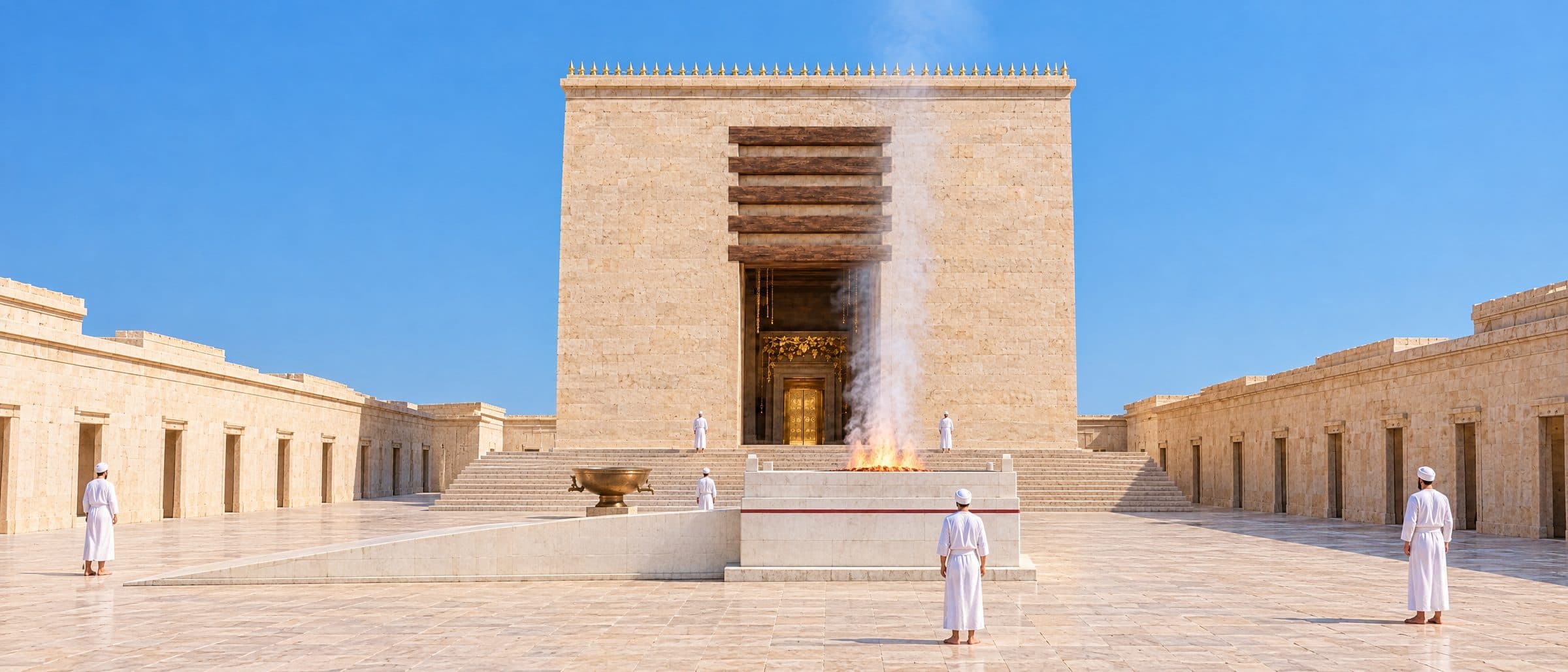
Service explorer
Night
An ordinary day
Reconstructed from Mishnah Tamid, which describes the daily service step by step. Times follow the sun, as the sources do; the site does not invent clock times.
- NightThe Azarah (inner courtyard)
The night watch
Mishnah / Talmud: Recorded in the Mishnah or Talmud, the rabbinic texts that preserve Temple practice and law.- What you see
- Kohanim sleep in the vaulted fire chamber, the elders holding the Temple keys. Levites keep watch at twenty-one posts; priests at three.
- What it means
- The House is never unattended. Guarding is itself a form of service.
- Where it comes from
- Around cock-crowThe Great Altar
Removing the ashes
Mishnah / Talmud: Recorded in the Mishnah or Talmud, the rabbinic texts that preserve Temple practice and law.- What you see
- Priests who wish to serve immerse before the officer arrives. Once, they raced up the ramp for the privilege; after an injury the Sages instituted a lottery. The winner takes a shovel of ashes from the altar and sets it beside the ramp.
- What it means
- The day begins by clearing yesterday's service: a small, physical act of renewal.
- Where it comes from
- Around cock-crowThe Great Altar
Arranging the fire
Torah text: Stated in the Five Books of Moses.- What you see
- The priests wash at the laver, climb the altar, push unburned pieces to the sides, and build the wood arrangements for the day.
- What it means
- The Torah commands that the fire on the altar never go out.
- Where it comes from
- Around cock-crowThe Chamber of Hewn Stone
The second lottery
Mishnah / Talmud: Recorded in the Mishnah or Talmud, the rabbinic texts that preserve Temple practice and law.- What you see
- In the Chamber of Hewn Stone, lots assign thirteen tasks: slaughtering, receiving the blood, clearing the inner altar and the Menorah, and carrying each part of the offering.
- What it means
- Every task is shared out. No one owns the service.
- Where it comes from
- First light over HebronThe Azarah (inner courtyard)
First light as far as Hebron
Mishnah / Talmud: Recorded in the Mishnah or Talmud, the rabbinic texts that preserve Temple practice and law.- What you see
- A watcher on a high point calls out when the eastern sky has brightened. The offering waits for daylight.
- What it means
- The service keeps time with the created world, not with a clock.
- Where it comes from
- SunriseThe Place of Slaughter
The morning Tamid
Torah text: Stated in the Five Books of Moses.- What you see
- One lamb, examined for blemishes, is brought to the north side. Its blood is applied to the altar. The site shows this only as a diagram.
- What it means
- The communal offering of the whole people, every day, 'continually'.Torah text; the reading of it as the people's shared offering is supported by the institution of the maamadot.
- Where it comes from
- SunriseThe Heichal (the Holy)
Tending the Menorah and the inner altar
Mishnah / Talmud: Recorded in the Mishnah or Talmud, the rabbinic texts that preserve Temple practice and law.- What you see
- Inside the Heichal, one priest clears the ashes of the golden altar; another cleans the lamps of the Menorah, leaving any still burning in the east.
- What it means
- Light and fragrance are renewed each morning, as the Torah commands.
- Where it comes from
- MorningThe Chamber of Hewn Stone
Blessing and the Shema
Mishnah / Talmud: Recorded in the Mishnah or Talmud, the rabbinic texts that preserve Temple practice and law.- What you see
- The priests gather: one blessing, the Ten Commandments, the three paragraphs of the Shema, and further blessings.
- What it means
- Prayer and Torah stood inside the Temple's own daily order. Sacrifice and prayer were never opposites.
- Where it comes from
- MorningThe Heichal (the Holy)
The incense
Mishnah / Talmud: Recorded in the Mishnah or Talmud, the rabbinic texts that preserve Temple practice and law.- What you see
- A third lottery chooses a priest who has never offered incense. Everyone withdraws; he spreads the incense on the golden altar alone, bows, and leaves.
- What it means
- The most intimate act of the daily service, given to someone for the first time.
- Where it comes from
- MorningThe Porch
The priestly blessing
Mishnah / Talmud: Recorded in the Mishnah or Talmud, the rabbinic texts that preserve Temple practice and law.- What you see
- The priests stand on the steps of the Porch and bless the people with the words of Numbers 6, hands raised above their heads.
- What it means
- The blessing that kohanim still give in synagogues today, here in its original setting.
- Where it comes from
- MorningThe Fifteen Steps
Libation, song and trumpets
Mishnah / Talmud: Recorded in the Mishnah or Talmud, the rabbinic texts that preserve Temple practice and law.- What you see
- The limbs are placed on the fire. As the wine is poured, cymbals sound and the Levites sing the psalm of the day. At each pause the trumpets sound and the people bow.
- What it means
- Offering, music and the people's bowing form one act.
- Where it comes from
- MiddayThe Court of Israel
The people's offerings
Mishnah / Talmud: Recorded in the Mishnah or Talmud, the rabbinic texts that preserve Temple practice and law.- What you see
- Through the day individuals bring their offerings: thanksgiving, shared meals, grain offerings, purification offerings. Courts sit at the Temple's gates and in the Chamber of Hewn Stone.
- What it means
- The House is a place of gratitude, law and teaching as well as sacrifice.
- Where it comes from
- Afternoon, as the sun declinesThe Great Altar
The afternoon Tamid
Torah text: Stated in the Five Books of Moses.- What you see
- The second lamb of the day, offered 'at dusk' in the Torah's words, in the same order as the morning.
- What it means
- The day closes as it opened. Many hold that Minchah, the afternoon prayer, stands in its place today.Bavli Berakhot 26b records that view alongside one tracing the prayers to the patriarchs.
- Where it comes from
- DuskThe Heichal (the Holy)
Lamps and incense at dusk
Torah text: Stated in the Five Books of Moses.- What you see
- The Menorah is lit and the evening incense offered.
- What it means
- Light carried into the night.
- Where it comes from
- DuskThe Azarah (inner courtyard)
Closing
Torah text: Stated in the Five Books of Moses.- What you see
- The gates close. The fire on the altar burns through the night.
- What it means
- A continuous flame: the service rests, the fire does not.
- Where it comes from
What is known?Confidence, from primary text to unknown
Established in primary text
- The order of the morning service, the lotteries and the Levites' daily psalms.
Classical interpretation
- Interpretations of what each act means. Where they differ, the page says whose reading it is.
Historically supported
Nothing on this page at this level.
Reconstructed
- Where a step happens is placed on the site's model; the order within a sun phase follows the Mishnah.
Unknown
- Modern clock times. The sources count by the sun, so the site does too.