דיוק
How the site knows what it says
- Sources in the library
- 428
- Verified primary texts
- 365
- Verified liturgy excerpts
- 40
- Sources cited on the site
- 365
The source hierarchy
When sources differ, the site gives more weight to those higher on this list, and says when it is reporting a view lower down.
- Torah and Tanach
- Mishnah and Talmud
- Rambam, especially the laws of the Chosen House
- Classical commentators and recognised halachic sources
- Josephus, as historical literature rather than halachic authority
- Archaeology and academic scholarship, for historical context
- Later traditional reconstruction scholarship
- Contemporary educational institutions
Labels you will see everywhere
Each label has a name, an icon and a border pattern, so its meaning never depends on colour.
- Torah text: Stated in the Five Books of Moses.Stated in the Five Books of Moses.
- Tanach prophecy: Stated in the Prophets or the Writings.Stated in the Prophets or the Writings.
- Mishnah / Talmud: Recorded in the Mishnah or Talmud, the rabbinic texts that preserve Temple practice and law.Recorded in the Mishnah or Talmud, the rabbinic texts that preserve Temple practice and law.
- Halachah: Rambam: Codified as Jewish law by Maimonides (Rambam) in the Mishneh Torah.Codified as Jewish law by Maimonides (Rambam) in the Mishneh Torah.
- Historical record: Ancient historical writing such as Josephus. Historical testimony, not religious law.Ancient historical writing such as Josephus. Historical testimony, not religious law.
- Archaeological evidence: Physical evidence from excavation or surviving monuments.Physical evidence from excavation or surviving monuments.
- Classical interpretation: A traditional commentator's reading. Others may read the text differently.A traditional commentator's reading. Others may read the text differently.
- Reconstruction: A choice this site made to draw or model something the sources do not fully specify.A choice this site made to draw or model something the sources do not fully specify.
- Future / prophetic: Describes what prophecy or tradition expects. Not a historical fact.Describes what prophecy or tradition expects. Not a historical fact.
- Open question: The sources disagree or are silent. The site does not choose an answer.The sources disagree or are silent. The site does not choose an answer.
Verified texts, and no invented quotations
Every Hebrew and English passage shown is fetched from a published edition through Sefaria and stored with its licence. Hebrew is from public-domain editions. English is the 1917 JPS translation (public domain), the Sefaria Community Translation (CC0), or CC-BY translations, each credited.
Where the only available English is not licensed for reuse (much of the Talmud), the site paraphrases and says so in the source's note.
A build-time audit fails if any quotation of six words or more on the site cannot be matched to the verified corpus, if a cited source does not exist, or if any page contains an em or en dash. Its latest report is kept in the repository at docs/content-audit.md.
The site's translations of prayers are its own, made from the verified Hebrew, and labelled as such.
How the images were made
Every photographic-looking image of the Temple on this site was generated with Higgsfield from a written visual bible and the reconstruction log, and every one carries a label.
Before any image was made, the site fixed the geometry (Mishnah Middot as codified by Rambam), materials, light, clothing and camera language, and a list of things never to show: domes, crosses, any present-day religious building or its removal, the Ark as present, blood or slaughter, fantasy effects and lettering.
Images are used only for the Third Temple. Earlier Temples are shown with diagrams, never with generated pictures that could pass as evidence.
Images that showed something the sources forbid were rejected or cropped; one early image showed steps up to the altar, which the Torah forbids, and was cropped before use.
This image is an educational reconstruction generated from the site's architectural model and source assumptions. It is not a photograph, archaeological evidence, or a claim that every future architectural detail is known.
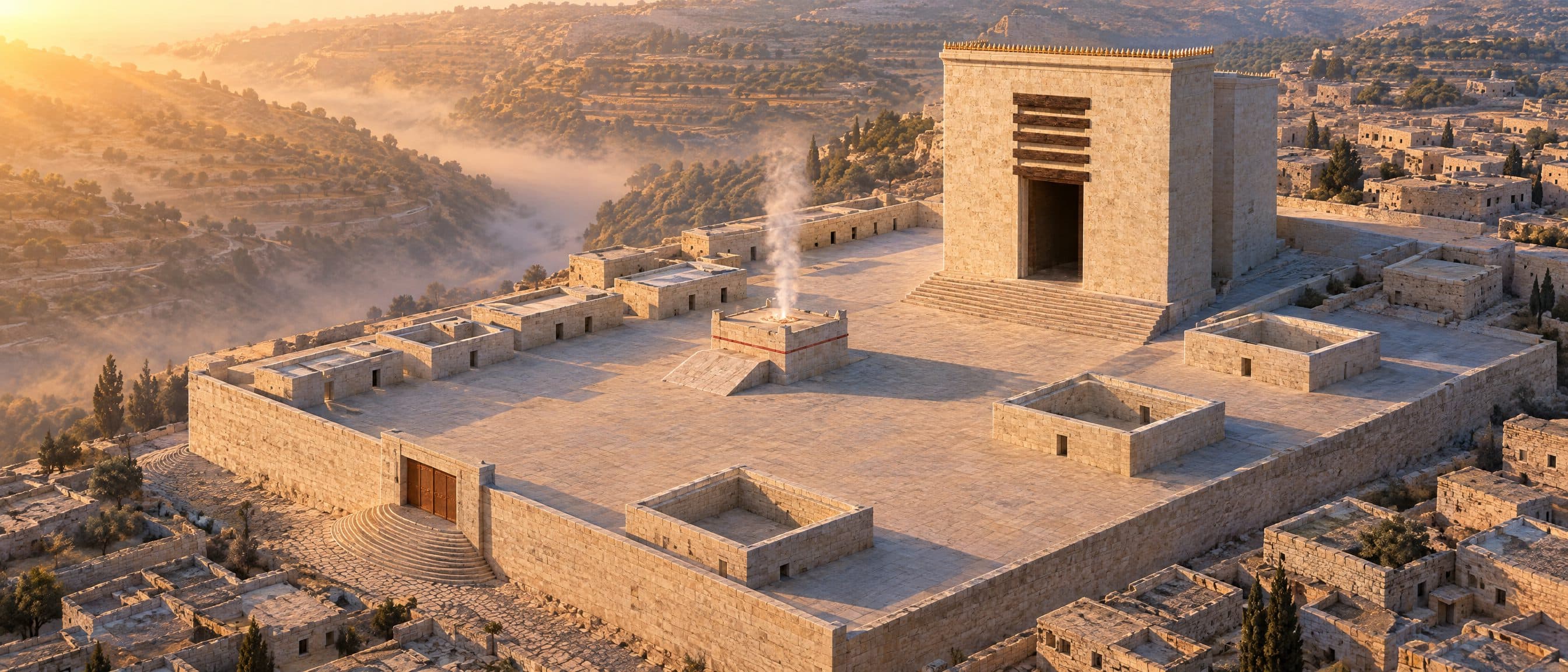
hero-dawn
Reconstruction: the Temple at dawn seen from the Mount of Olives, mist in the Kidron valley, the walled platform with the Court of Women and its open corner chambers, the broad low altar with its ramp, and the Sanctuary's square limestone front with a doorless opening under stacked lintels.
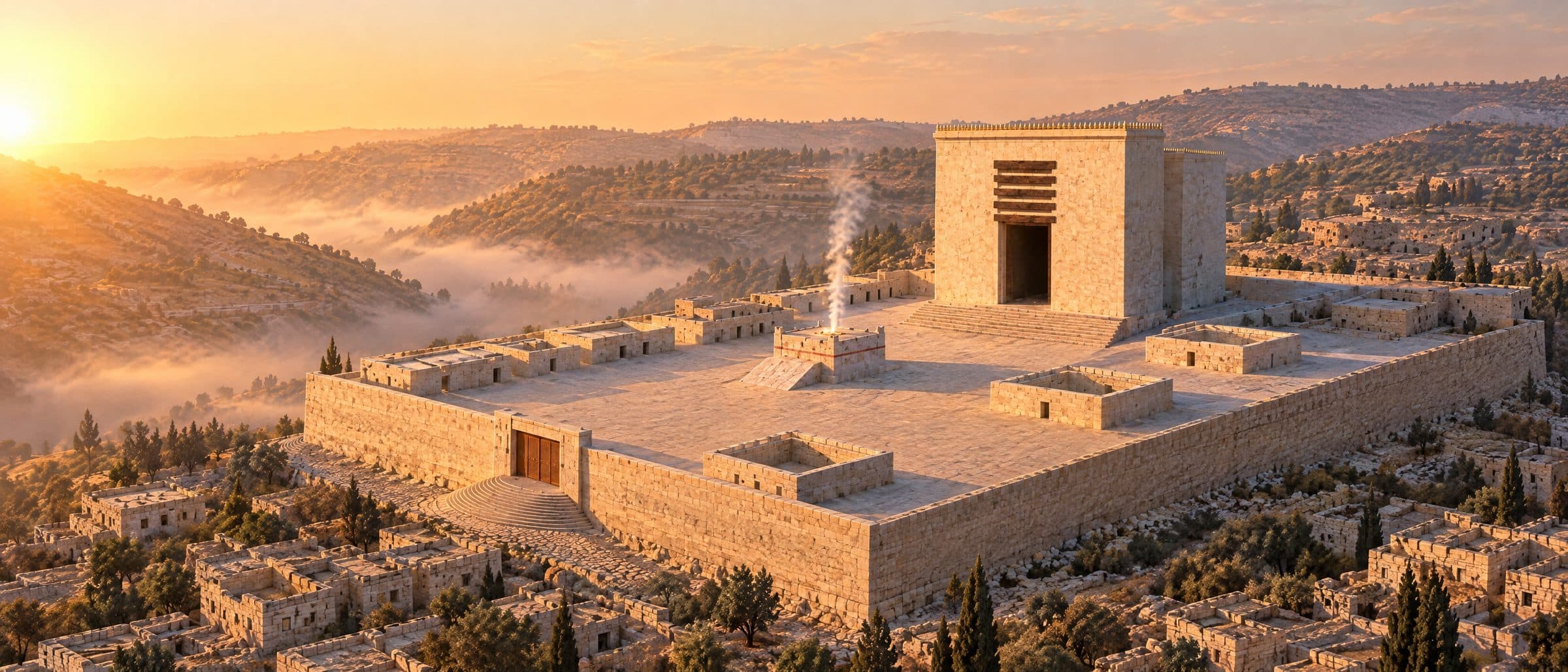
hero-dawn-alt
Reconstruction: sunrise over the Judean hills, the Temple platform on its ridge above a limestone city; the square-fronted Sanctuary, the low altar with a smooth ramp and a straight column of smoke.
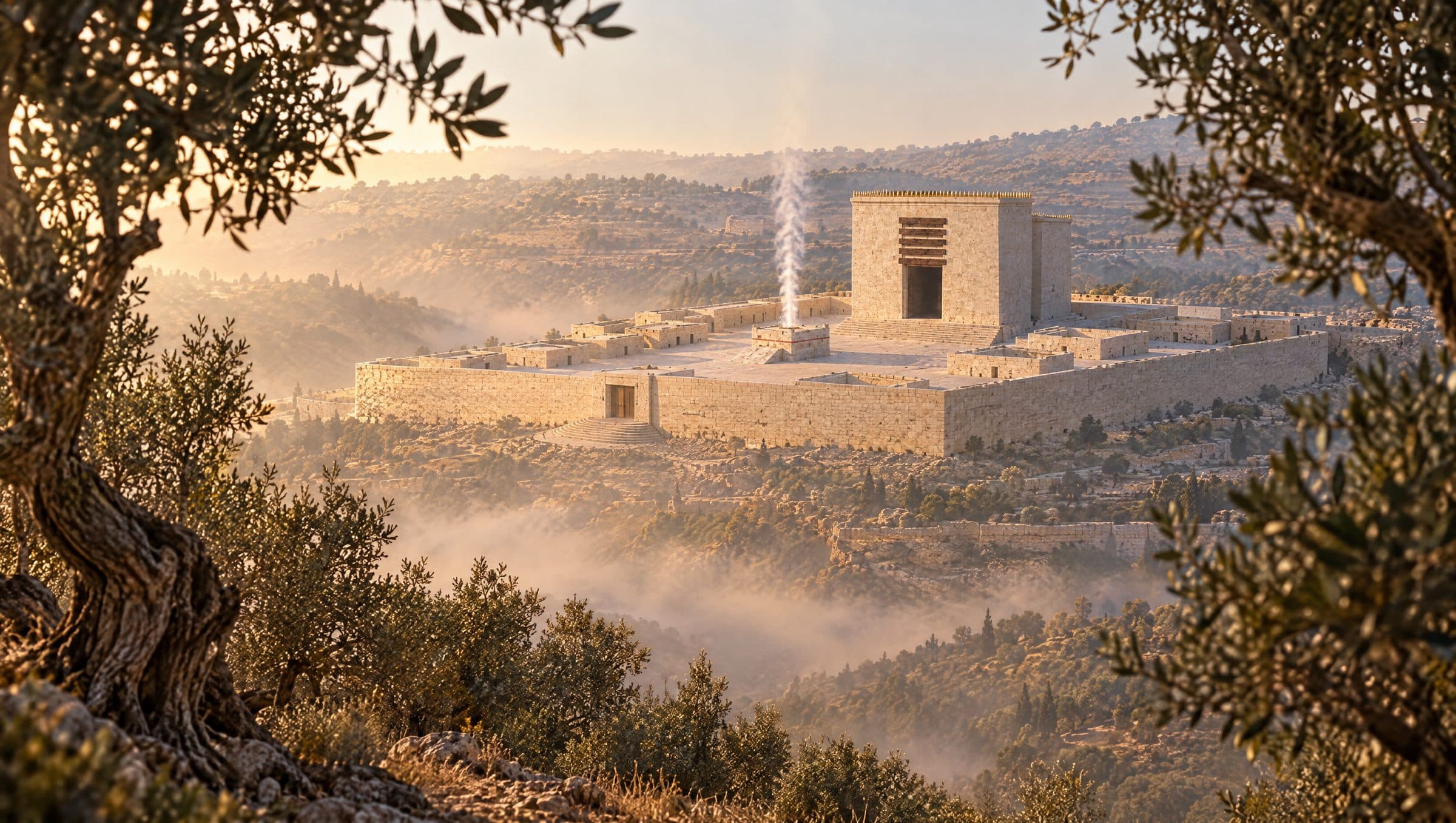
approach-olives
Reconstruction: view from among olive trees on the Mount of Olives across the misty Kidron valley to the Temple platform, smoke rising straight up from the altar before the square-fronted Sanctuary.
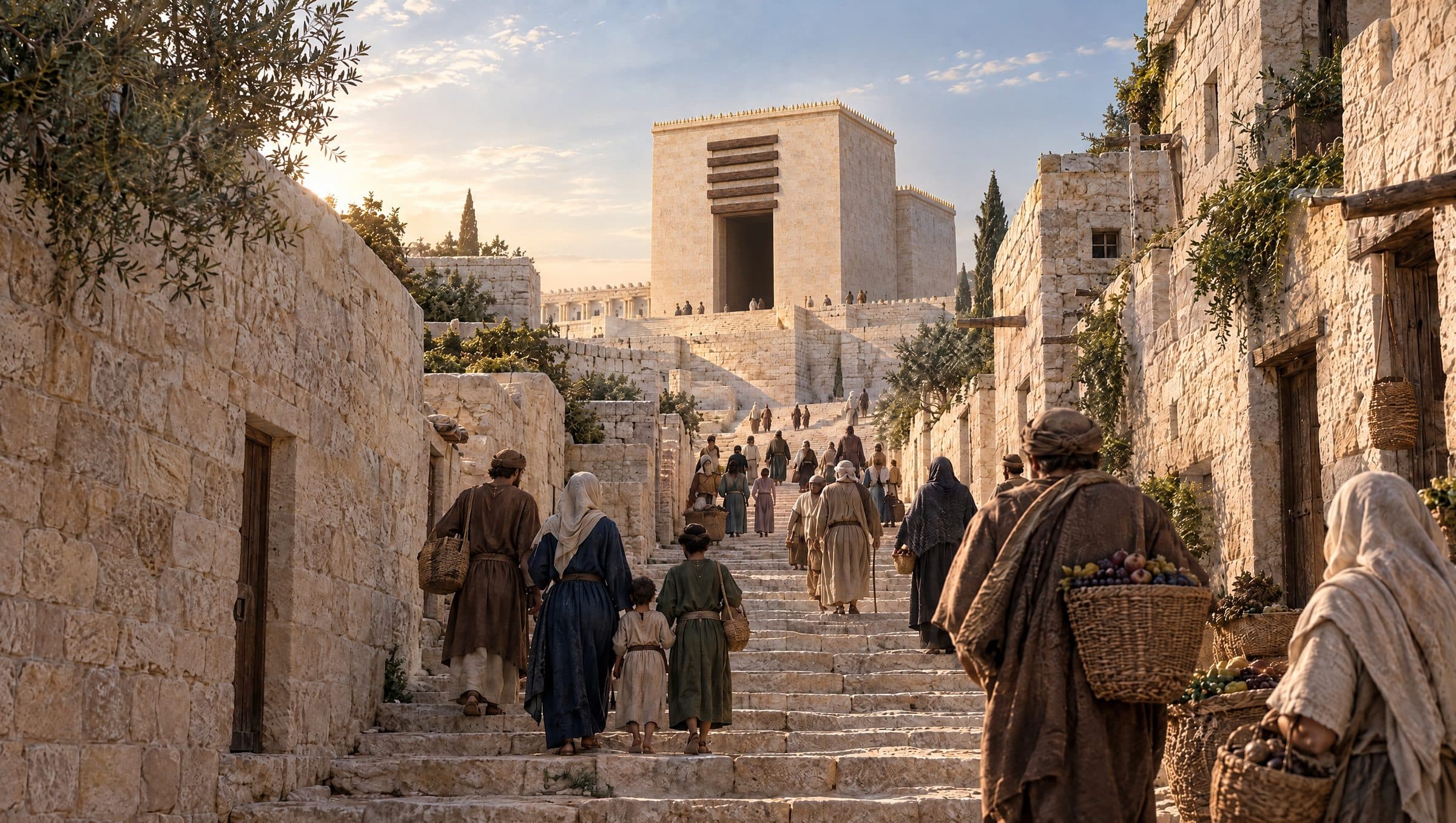
city-street
Reconstruction: pilgrims carrying baskets of first fruits climb a stepped limestone street toward the Temple; the Sanctuary's square front with its doorless opening and stacked lintels rises at the top of the street.
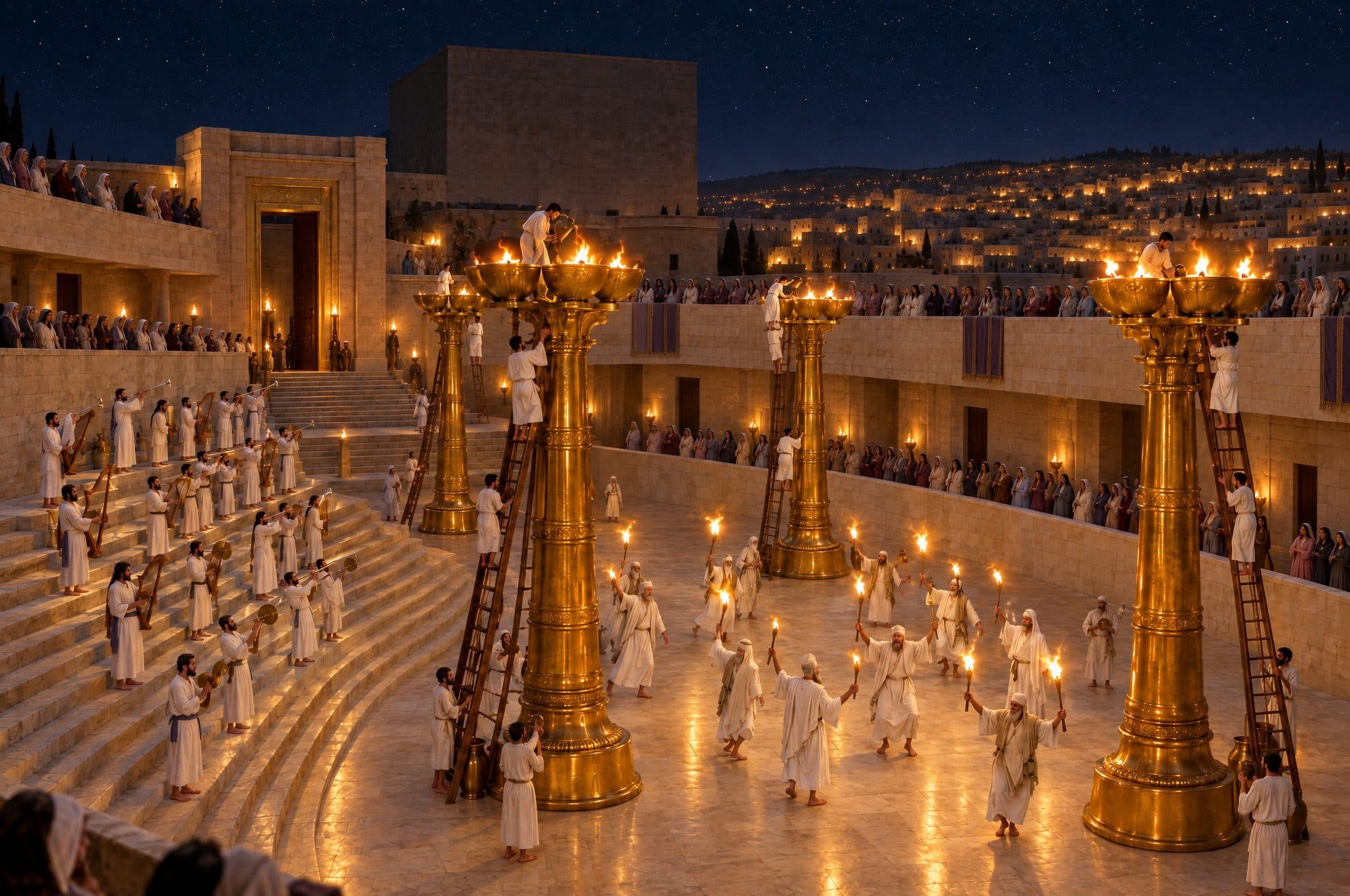
water-drawing
Reconstruction: night in the Women's Court during Sukkot, tall golden lamp-stands with ladders, barefoot elders dancing with torches, Levites with instruments on the fifteen curved steps, women watching from the balcony.
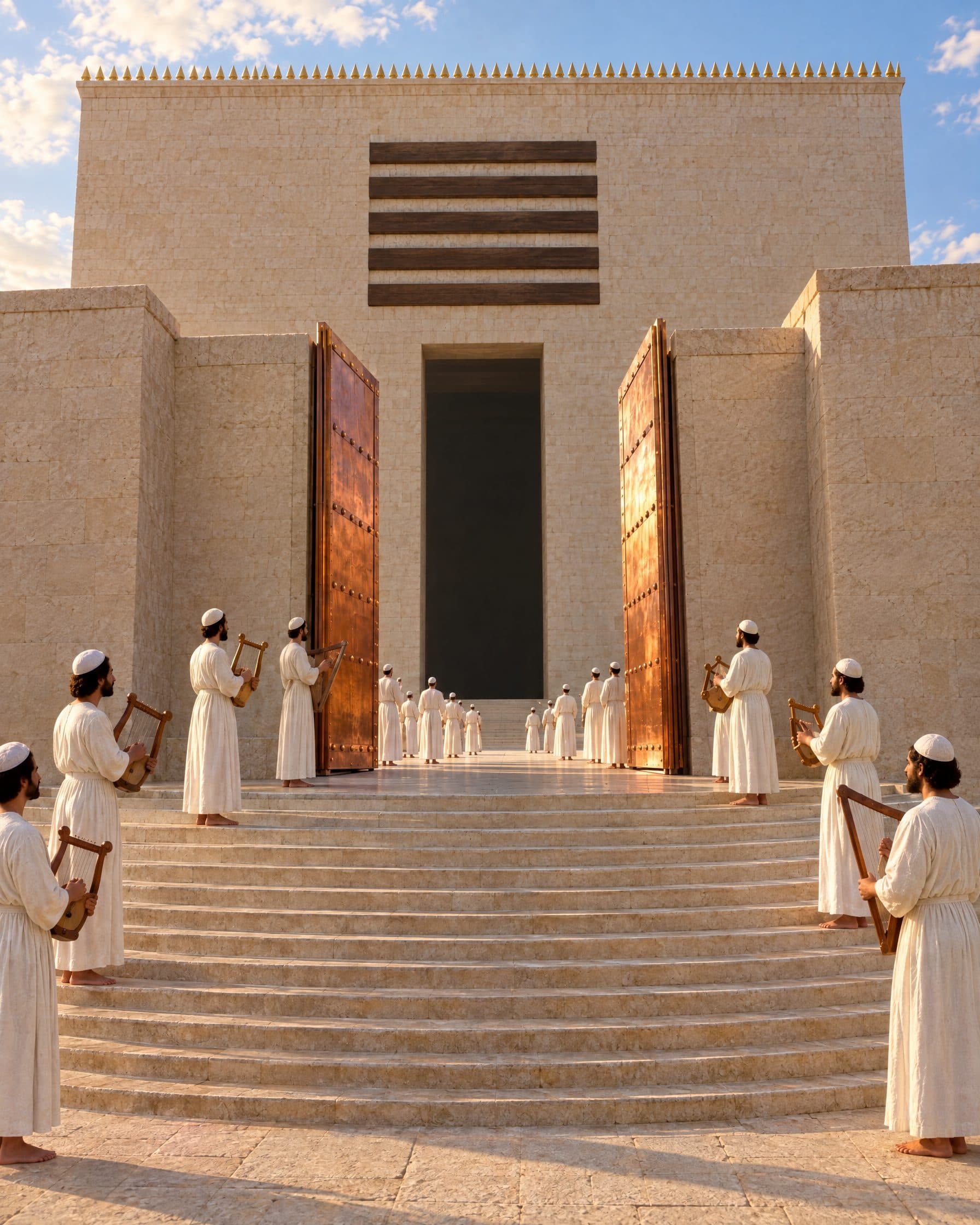
nicanor
Reconstruction: fifteen curved steps rise to the Nicanor gate with its open copper doors; barefoot Levites in white linen hold lyres; beyond, the Sanctuary's square front with its doorless opening and stacked oak lintels.
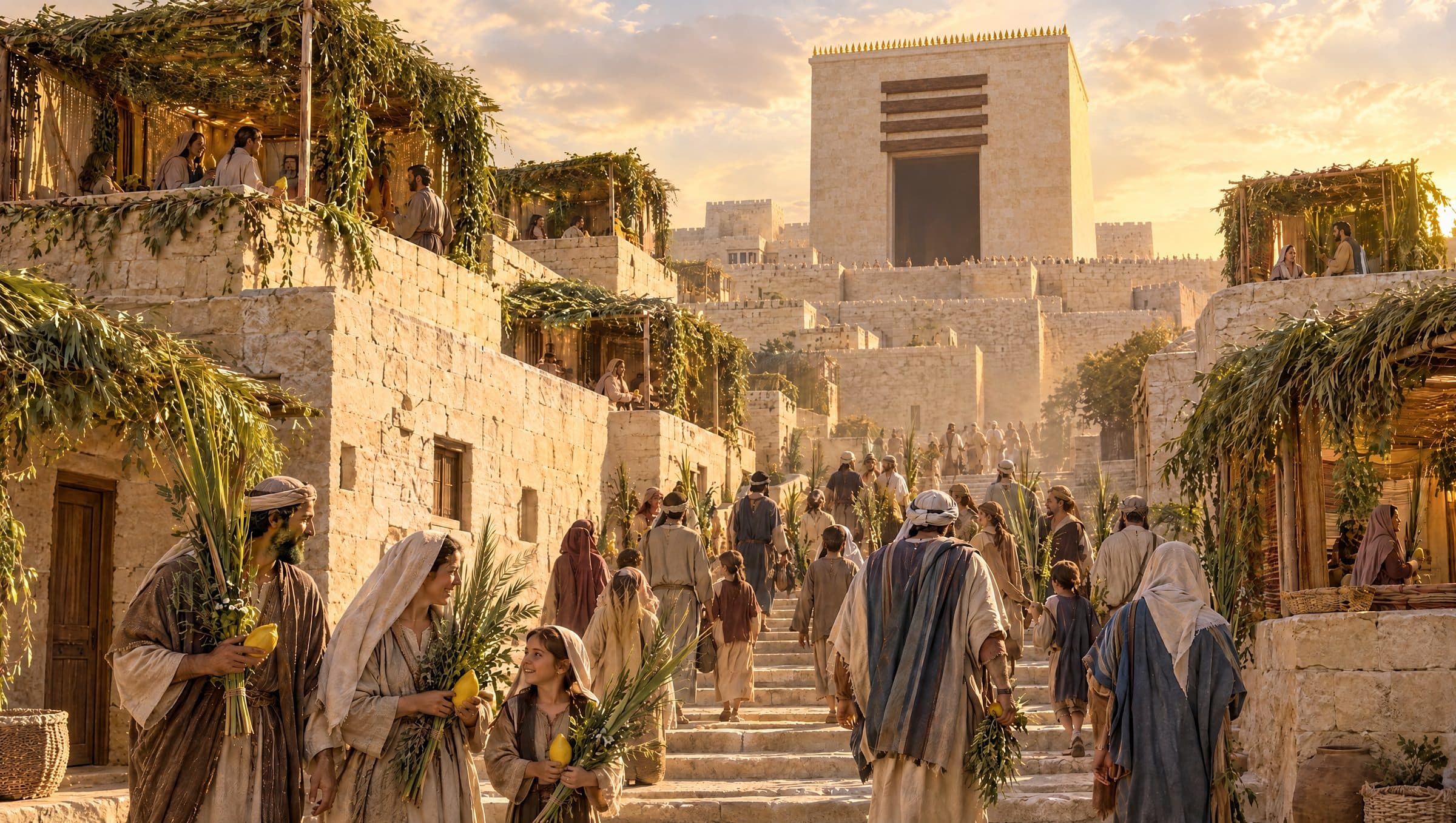
sukkot-pilgrims
Reconstruction: Sukkot pilgrims holding palm branches, myrtle, willow and citrons climb toward the Temple, with festival booths on the roofs of the city houses.
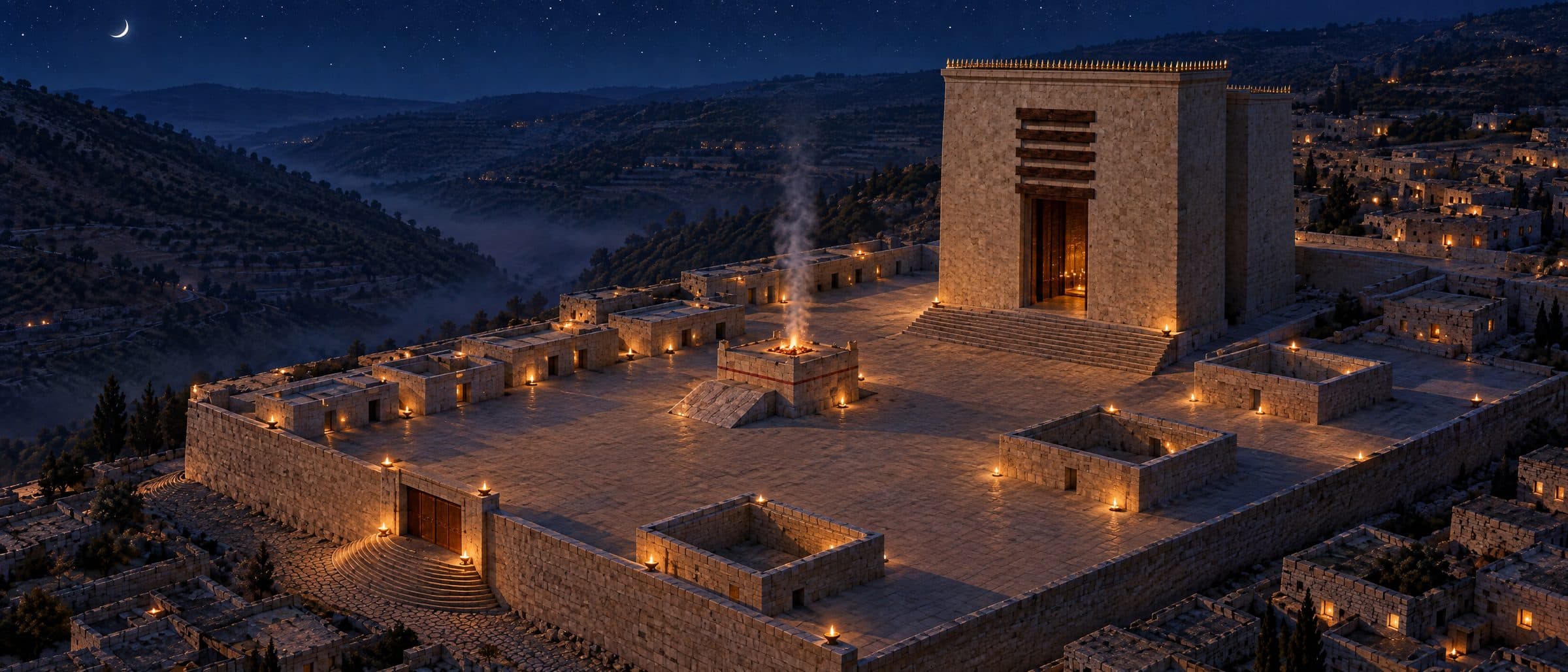
night-exterior
Reconstruction: the Temple platform at night under stars and a thin crescent moon, the Sanctuary's open doorway glowing, the courts lit only by oil lamps and the embers of the altar.
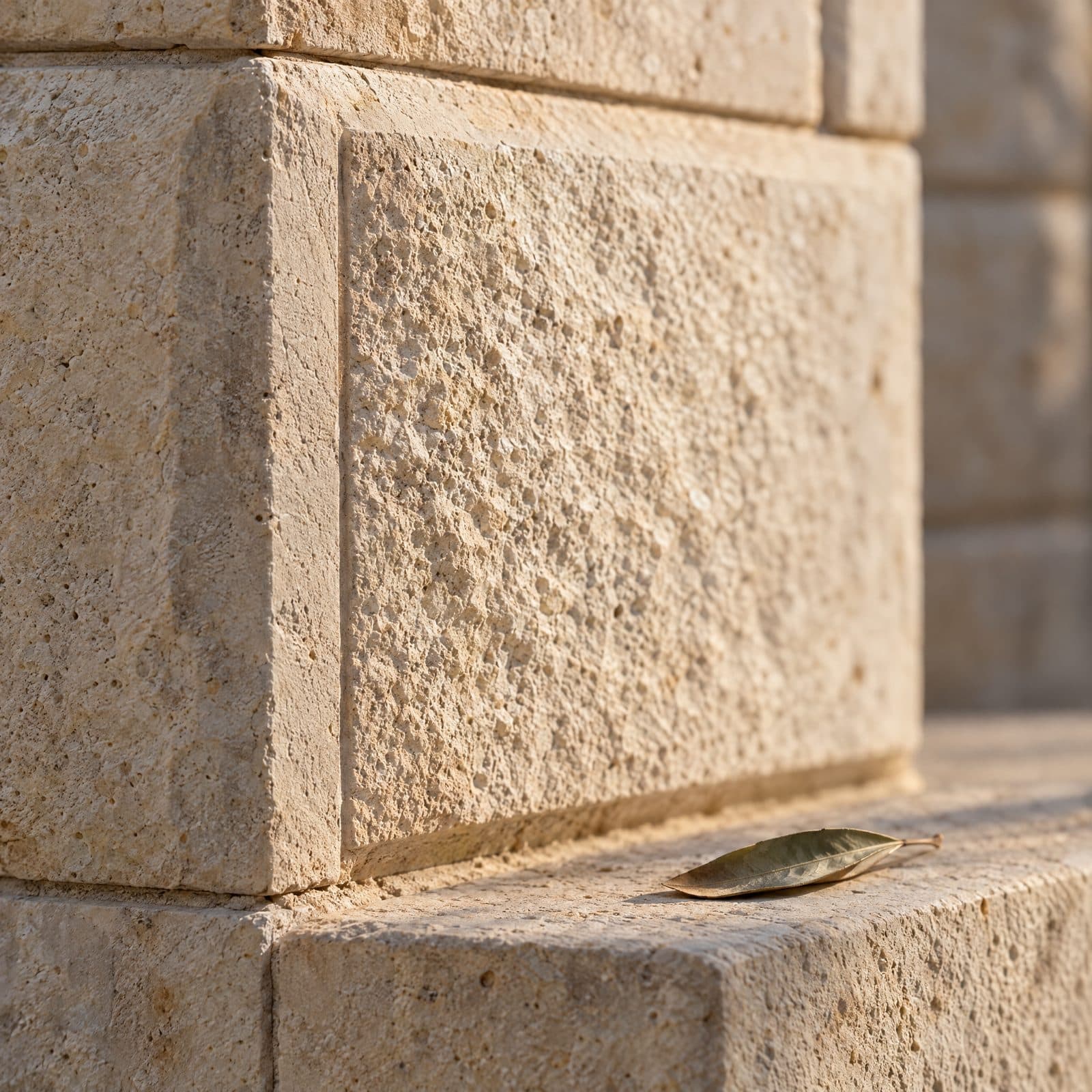
stone-macro
Close-up of pale limestone ashlar with drafted margins in raking morning light, an olive leaf on the ledge.
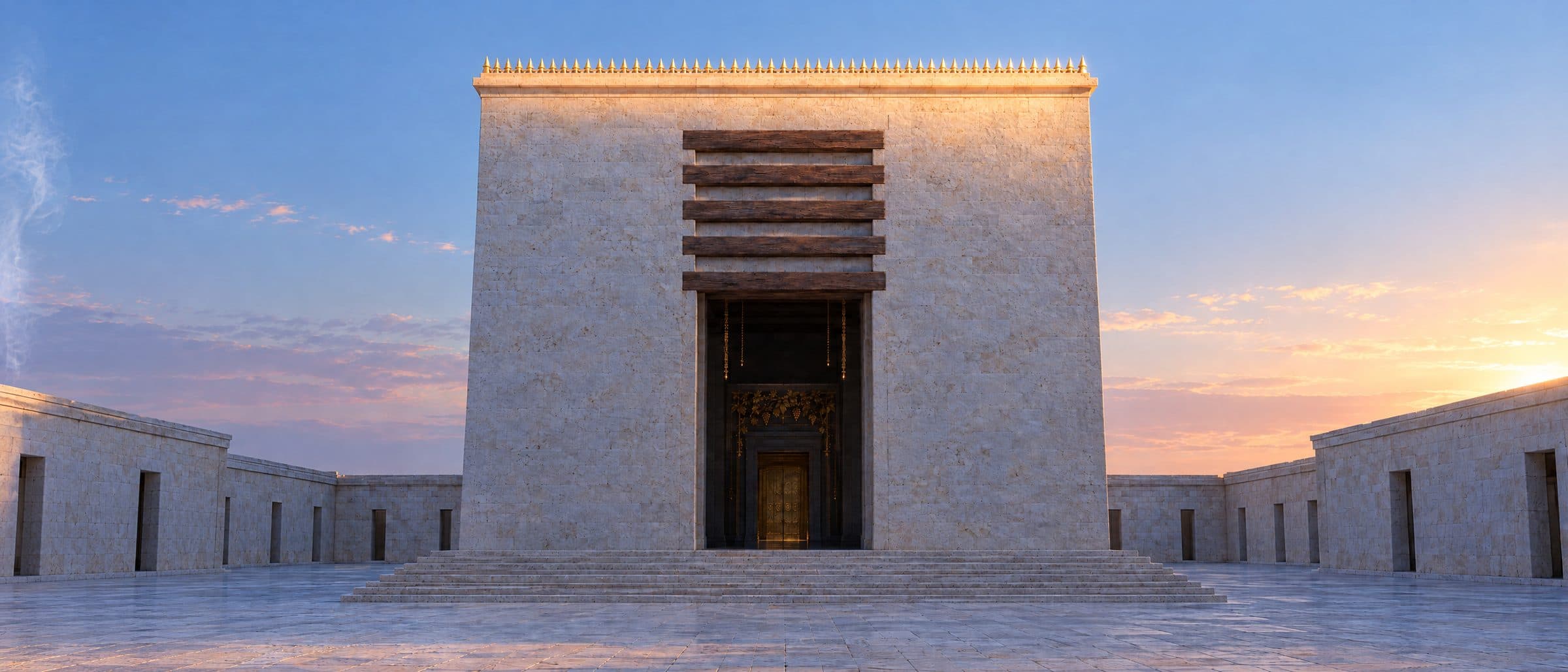
dawn-doorway
Reconstruction: the empty inner court at first light, seen from between the altar and the porch; twelve broad steps rise to the Sanctuary's doorless opening under five stacked oak lintels, the golden vine faintly visible inside.
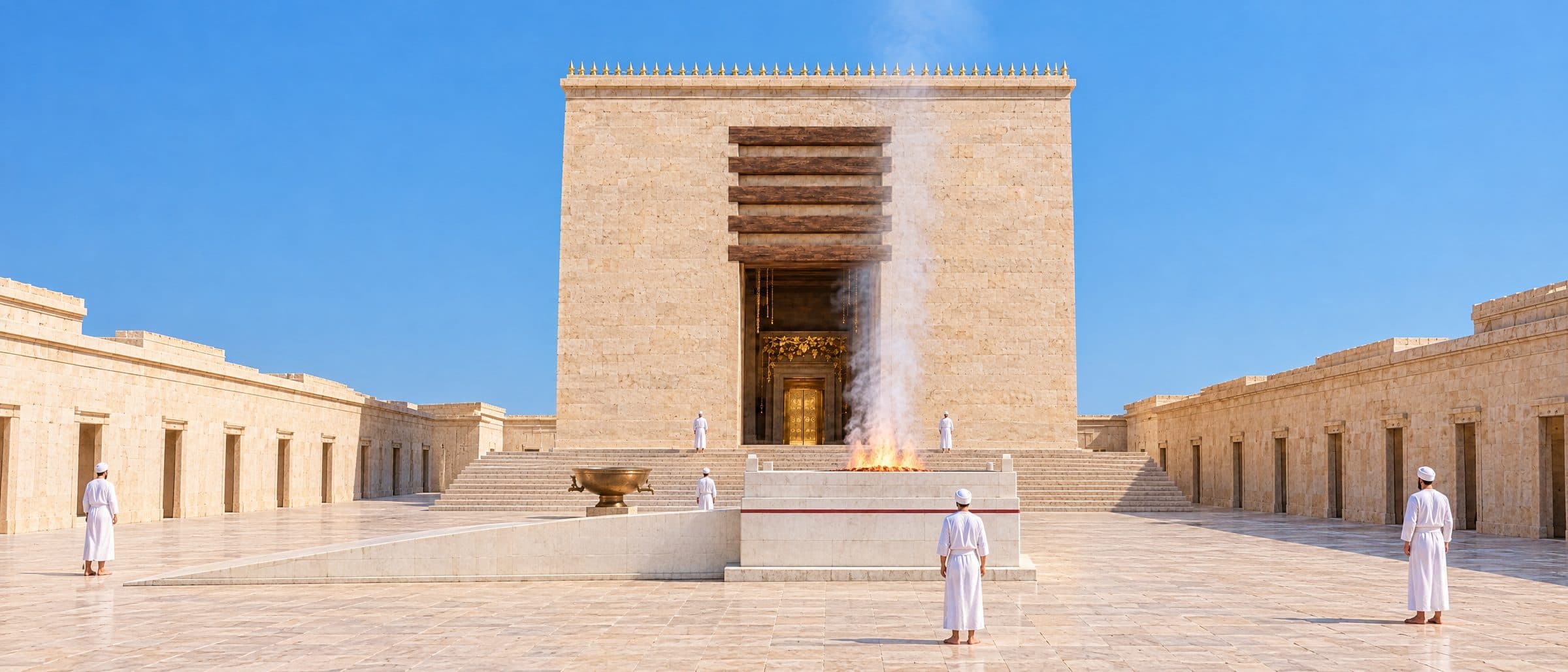
azarah
Reconstruction: the inner courtyard looking west along the axis; the altar with its red line stands before the Sanctuary, its smooth ramp running south, a bronze laver beside the steps, barefoot priests in white linen, and the Sanctuary's square front with its doorless opening and golden vine within.
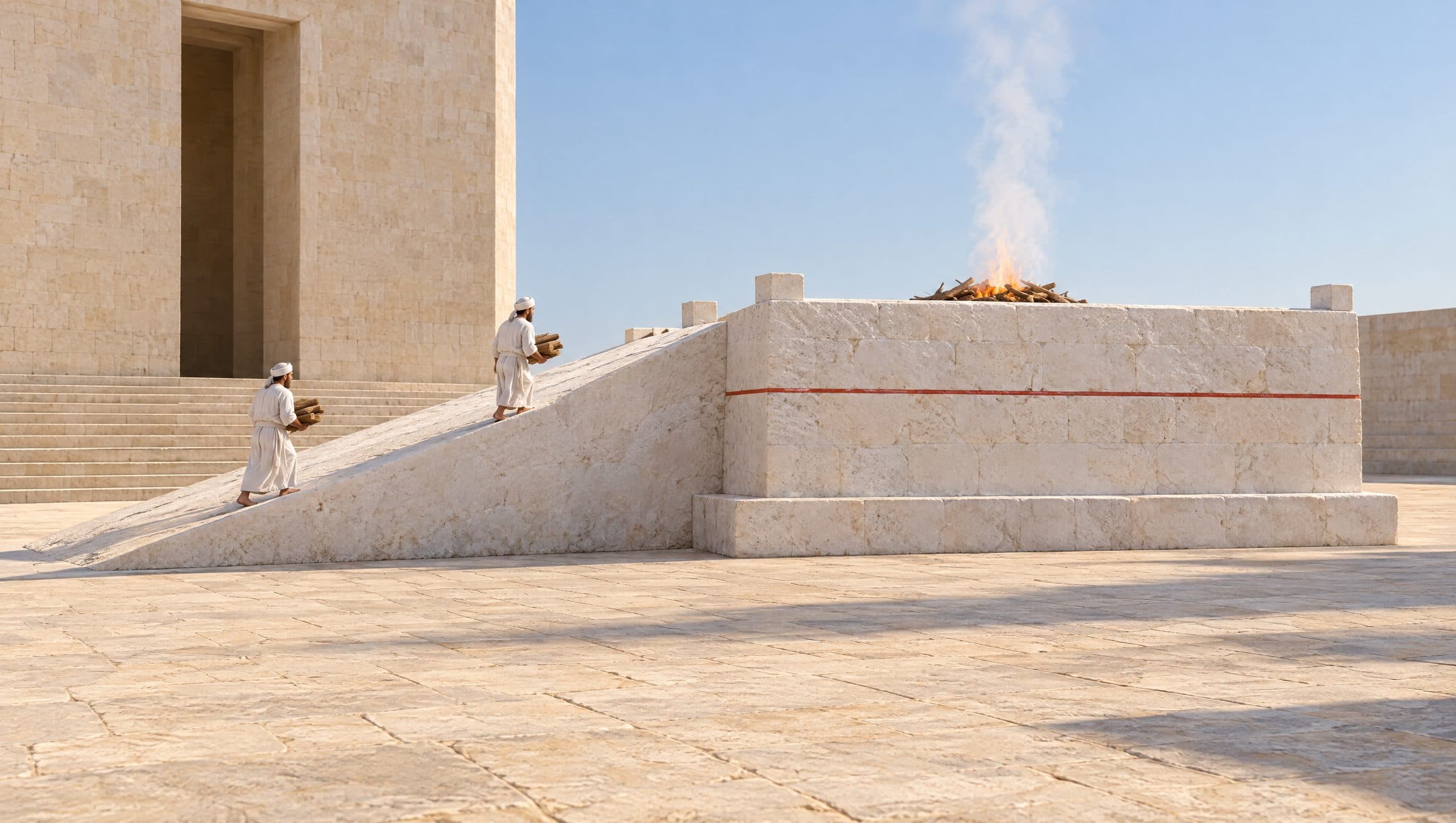
altar
Reconstruction: the great altar of whitewashed unhewn stone, broad and low, with a red line around its middle and square stone horns at its corners; two barefoot priests carry wood up the smooth ramp, which has no steps.
sanctuary
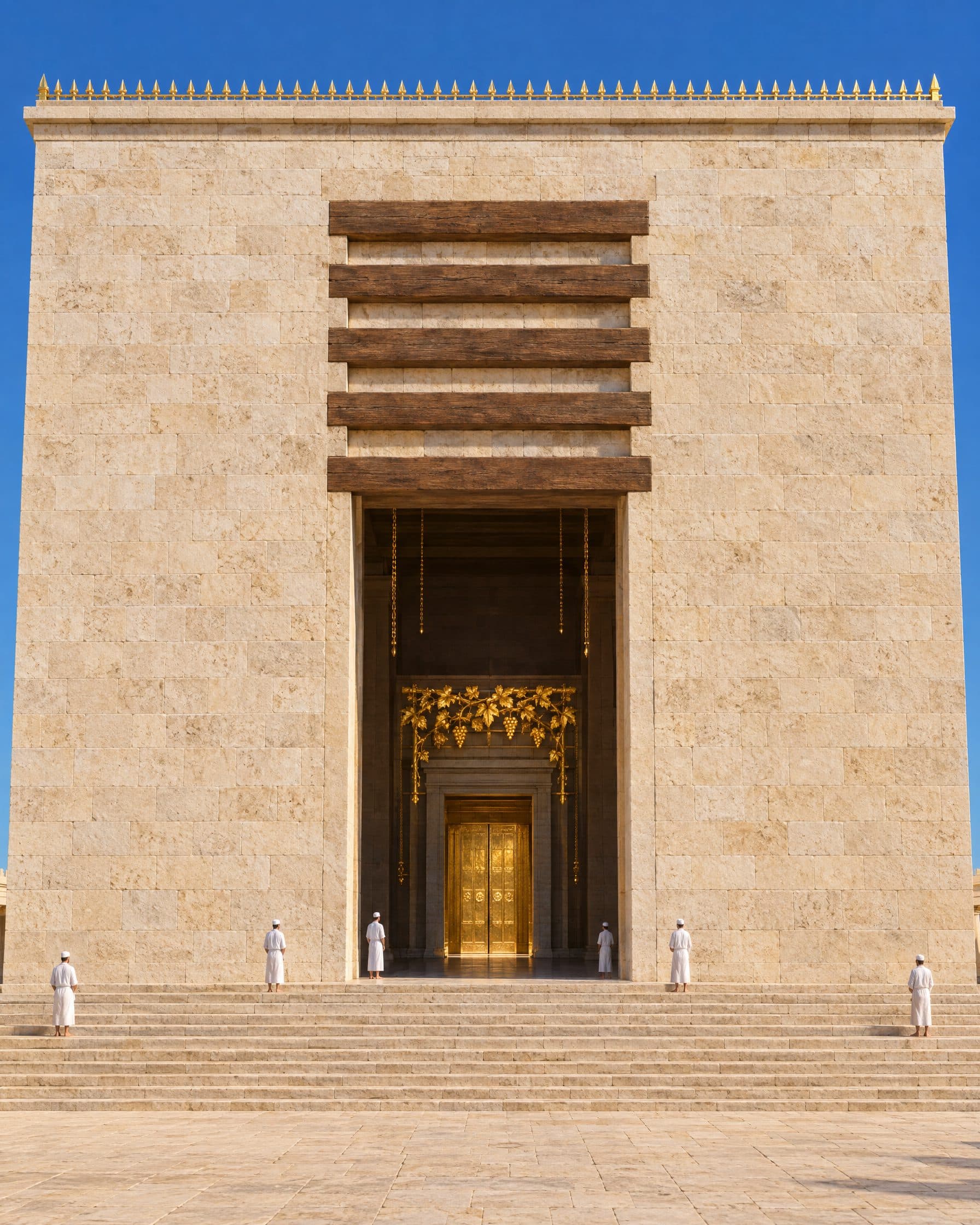
Reconstruction: the Sanctuary facade, a square limestone front with a doorless opening under five stacked oak lintels; inside the porch the golden vine above the gold-plated doors of the Heichal; barefoot priests on the twelve steps.
heichal
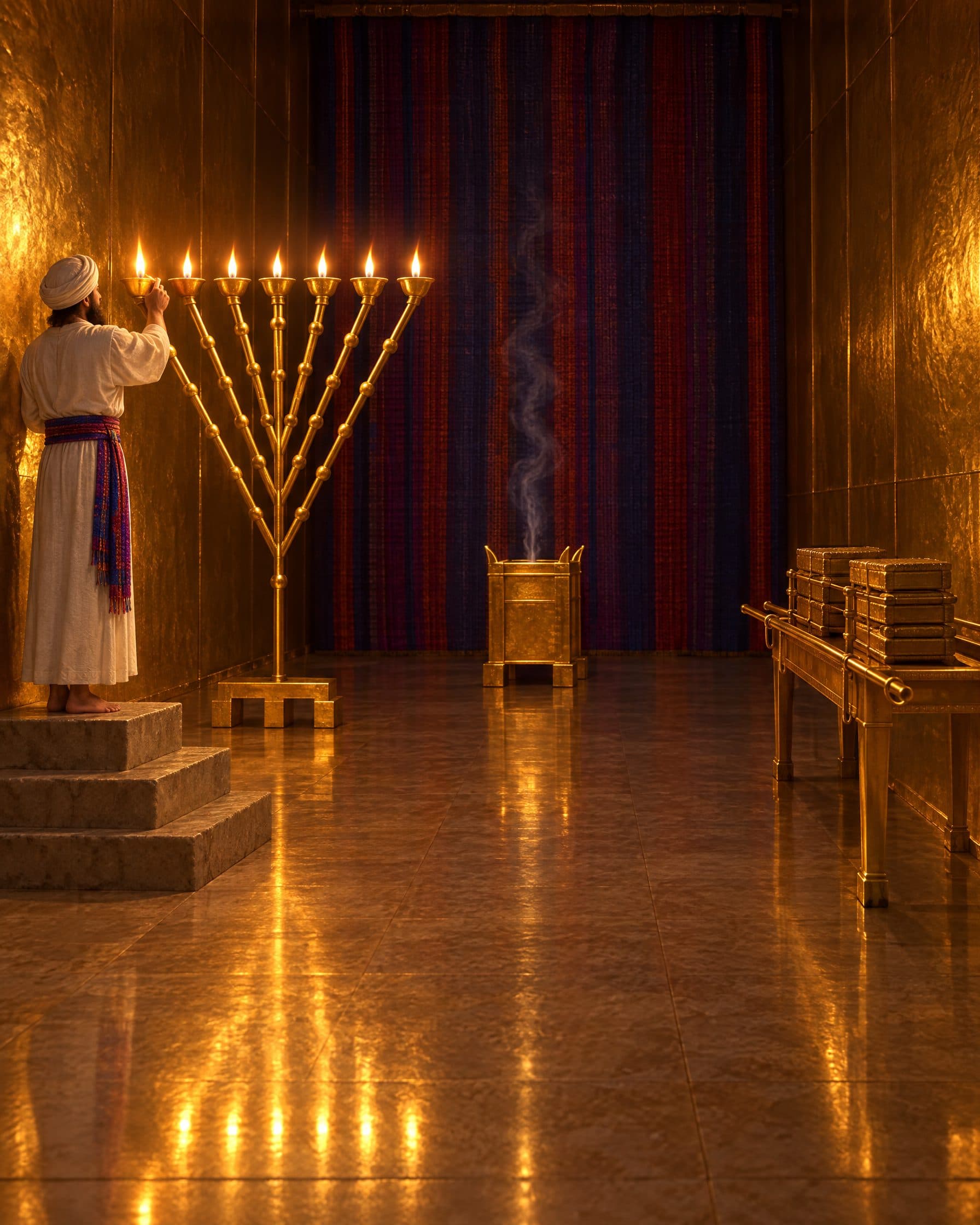
Reconstruction: inside the gold-lined Heichal, a barefoot priest on the three-step stone tends the Menorah, seven lamps level on straight diagonal branches; the incense altar and the Table with two stacks of six loaves; a woven curtain at the far end.
nations
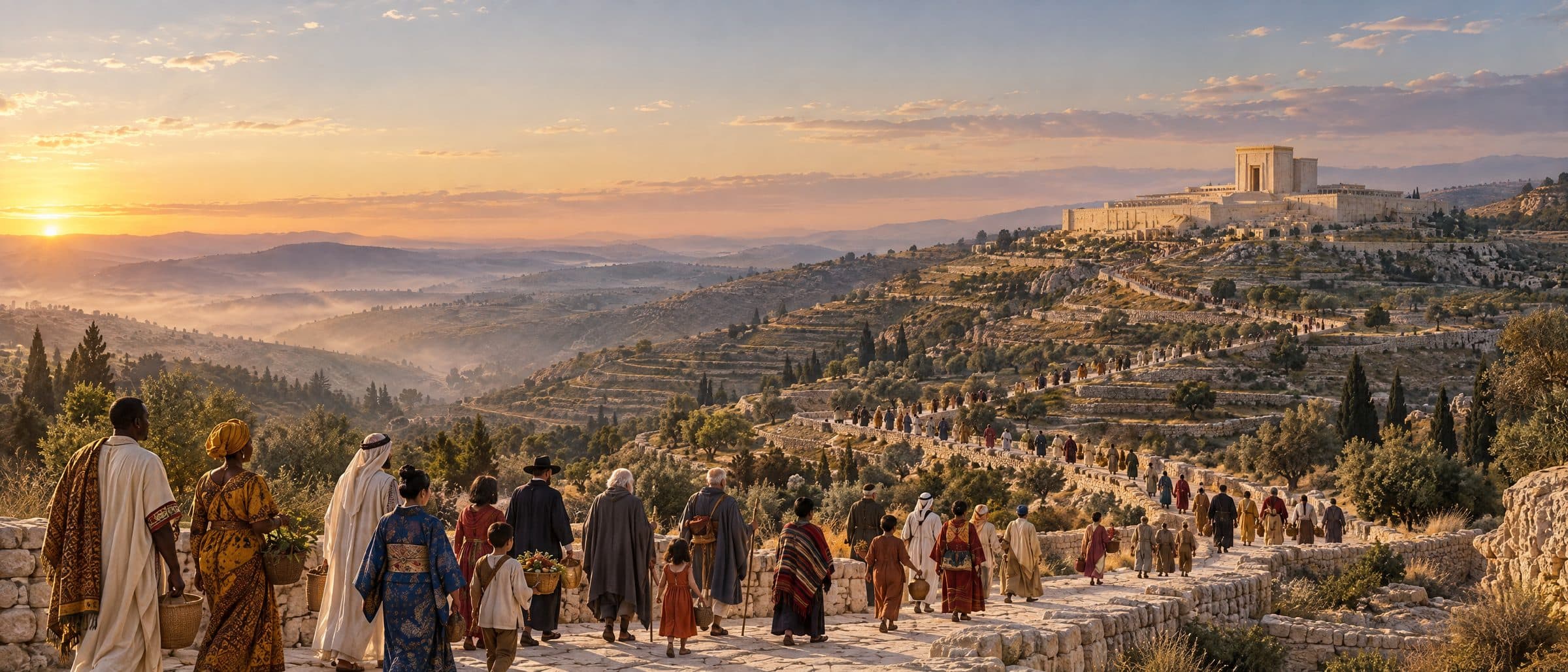
Reconstruction: people of many nations in their own traditional dress walk along terraced roads toward Jerusalem at sunrise; the Temple stands small on the distant ridge.
The full decision log is on the reconstruction decisions page.