Skip to content
Beit HaMikdash

כִּי בֵיתִי בֵּית־תְּפִלָּה יִקָּרֵא לְכָל־הָעַמִּים

Why would the Jewish Temple matter to someone who isn't Jewish?

Because the Hebrew Bible says the House was never only for one people's prayers. And because Judaism never asked the world to become Jewish to be part of that picture.

וַהֲבִיאוֹתִים אֶל־הַר קָדְשִׁי וְשִׂמַּחְתִּים בְּבֵית תְּפִלָּתִי עוֹלֹתֵיהֶם וְזִבְחֵיהֶם לְרָצוֹן עַל־מִזְבְּחִי כִּי בֵיתִי בֵּית־תְּפִלָּה יִקָּרֵא לְכָל־הָעַמִּים׃

Even them will I bring to My holy mountain, And make them joyful in My house of prayer; Their burnt-offerings and their sacrifices Shall be acceptable upon Mine altar; For My house shall be called A house of prayer for all peoples.
The Holy Scriptures: A New Translation

One House, many nations

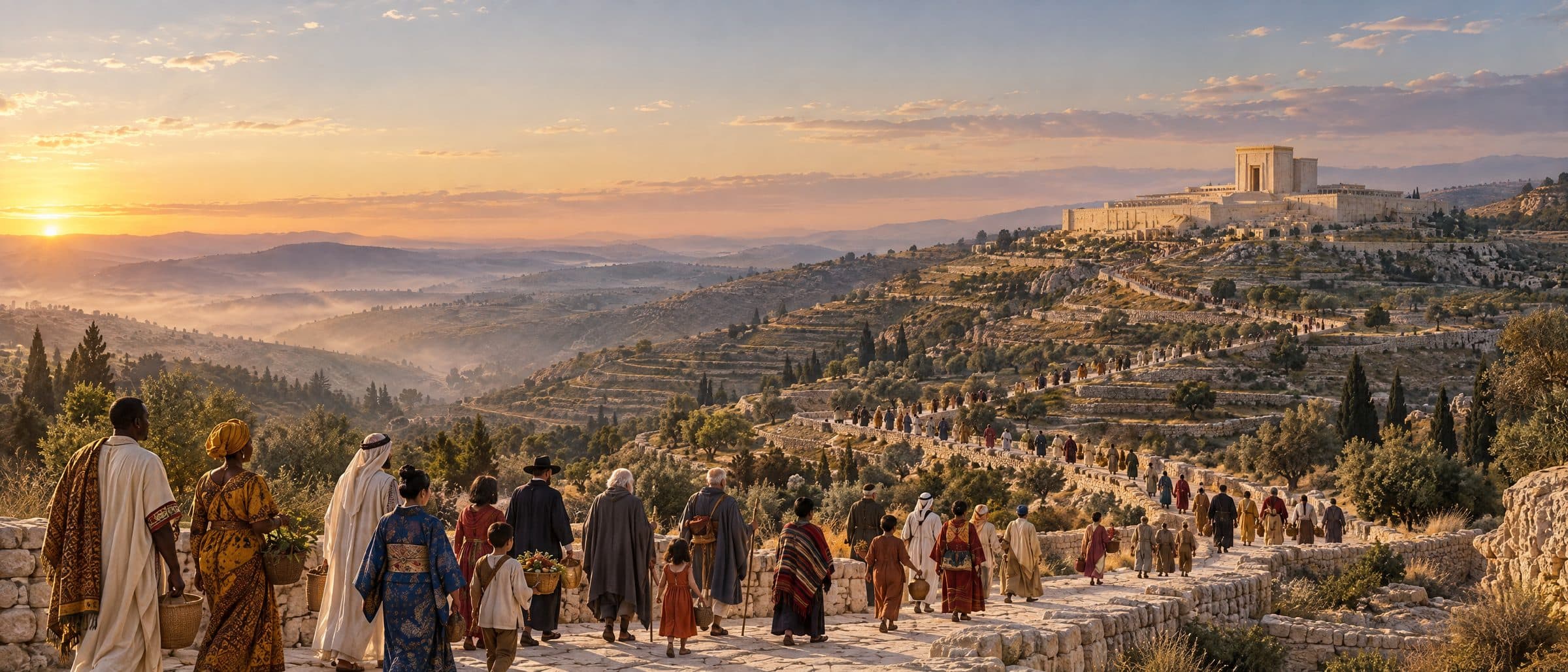
Zechariah imagines people ‘out of all the languages of the nations’ coming to Jerusalem. They keep their languages. They come as themselves.

ירושליםJerusalem

The names of twenty languages arranged around Jerusalem.

Judaism does not ask everyone to become Jewish

Classical interpretation: A traditional commentator's reading. Others may read the text differently.

Rambam rules that the pious of the nations of the world have a share in the world to come. The prophets picture nations who recognise God while remaining nations.
Solomon prays for the foreigner

Tanach prophecy: Stated in the Prophets or the Writings.

At the dedication of the first Temple, Solomon asks God to hear the foreigner who comes from a far country and prays toward the House, ‘that all the peoples of the earth may know Thy name’.

Isaiah's universal House

Tanach prophecy: Stated in the Prophets or the Writings.

Isaiah speaks of foreigners who join themselves to God, and of nations streaming to the mountain of the House to learn.

Zechariah's nations

Tanach prophecy: Stated in the Prophets or the Writings.

In a future era, many peoples come to seek God in Jerusalem, and the nations keep Sukkot there year by year.

A great Name among the nations

Tanach prophecy: Stated in the Prophets or the Writings.

Malachi says God's Name is great among the nations from the rising of the sun to its setting.

Particular and universal together

Classical interpretation: A traditional commentator's reading. Others may read the text differently.

Abraham's family is chosen so that all the families of the earth may be blessed through it. Israel is called a kingdom of priests: a priesthood exists to serve others.

Three honest questions

Would non-Jews be allowed in the Temple?

In the Second Temple, non-Jews could enter the Temple Mount itself, and brought offerings. A lattice, the soreg, marked the line they did not pass; a Greek warning stone from it survives.

Holiness was graded for everyone: most Jews could not enter the inner courts either, and only one person ever entered the Holy of Holies.

How access would work in a future Temple is not specified in the sources this site relies on. Isaiah gives the House a universal purpose. The site does not promise rules it cannot source.

Is this about converting the world to Judaism?

No, not in the ordinary missionary sense. Judaism does not seek converts and welcomes sincere ones.

The prophetic hope is that all people will recognise and serve the one God, each nation in its own place and language, not that all will become Jews.

Does Judaism believe the Temple belongs to humanity?

Its responsibility is given to Israel: the commandment, the priesthood, the service. Its purpose reaches everyone.

Both are in the texts at once, and the tradition has never felt a need to choose between them.

Reconstruction: people of many nations in their own traditional dress walk along terraced roads toward Jerusalem at sunrise; the Temple stands small on the distant ridge.