Skip to content
Beit HaMikdash
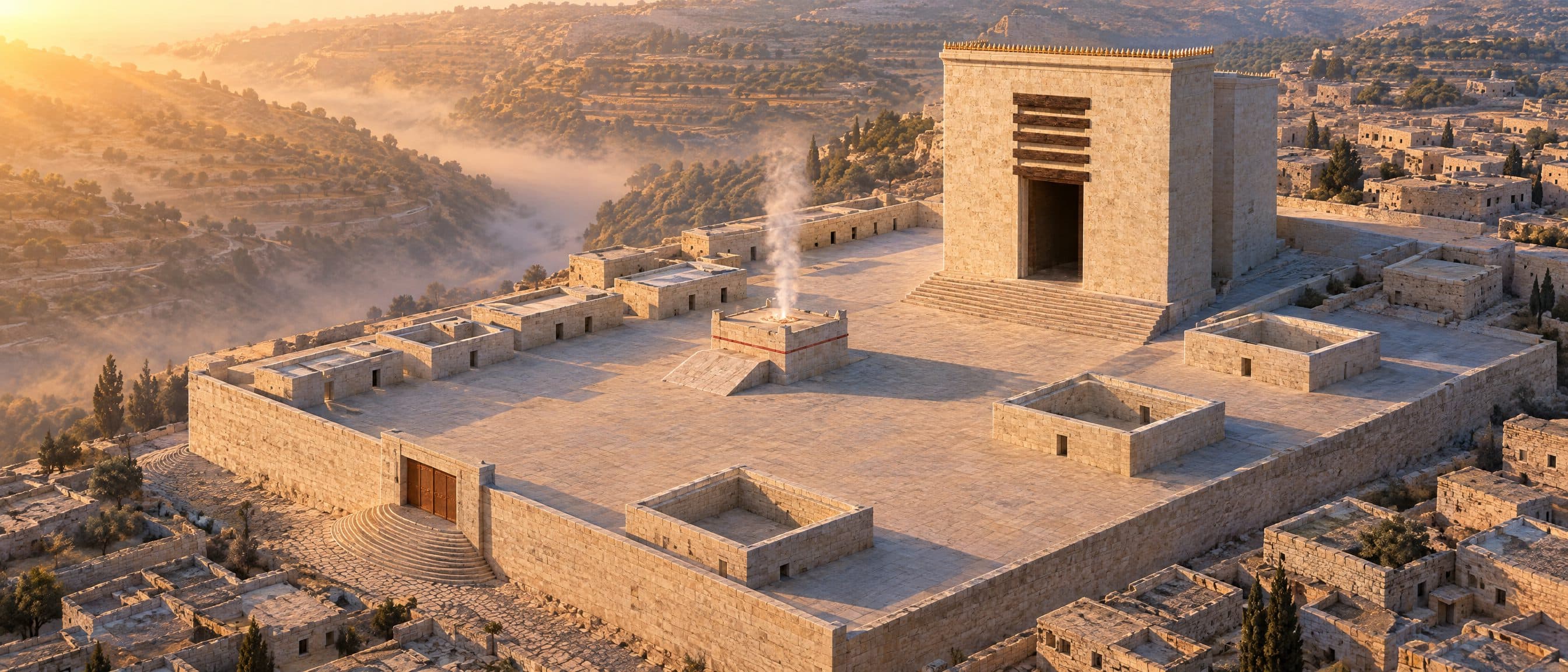
Reconstruction: the Temple at dawn seen from the Mount of Olives, mist in the Kidron valley, the walled platform with the Court of Women and its open corner chambers, the broad low altar with its ramp, and the Sanctuary's square limestone front with a doorless opening under stacked lintels.

The Houseבית המקדש

For nearly two thousand years, Jews have prayed toward Jerusalem and asked for the restoration of the Holy Temple.

What are they praying for?

Not a relic

The Temple in Jerusalem was destroyed in 70 CE. It never left Jewish life. It is in the Torah, which commands a sanctuary, and in the prophets, who promise one.

It is in the Amidah, said three times a day toward Jerusalem. It is in grace after meals, at the Seder, under the wedding canopy and on the fast of the Ninth of Av. The law still records its measurements. Mourners are still comforted among the mourners of Zion and Jerusalem.

Scroll, and every fragment turns toward the same place.

A sanctuary in the centre of a people

From the Garden to a future House. Not every link has the same textual standing, so each one carries its label.

01Classical interpretation: A traditional commentator's reading. Others may read the text differently.

עדן

Eden

Cherubim guard the way on the east. Commentators and scholars note parallels between the Garden and the Sanctuary.
More
02Classical interpretation: A traditional commentator's reading. Others may read the text differently.

הר המוריה

Akedah and Moriah

Chronicles names the Temple mount Moriah; Rambam records the tradition that the altar stands where Isaac was bound.

03Classical interpretation: A traditional commentator's reading. Others may read the text differently.

סיני

Sinai

Ramban: the glory that rested openly on Sinai rests, concealed, on the Mishkan.

04Torah text: Stated in the Five Books of Moses.

משכן

Mishkan

'Let them make Me a sanctuary, that I may dwell among them.'

More
05Halachah: Rambam: Codified as Jewish law by Maimonides (Rambam) in the Mishneh Torah.

שילה

Shiloh

A stone house roofed with the Mishkan's curtains, for 369 years in Rambam's count.

06Tanach prophecy: Stated in the Prophets or the Writings.

בית ראשון

First Temple

Solomon's House in Jerusalem, with the Ark in its innermost room.

More
07Tanach prophecy: Stated in the Prophets or the Writings.

גלות בבל

Exile

Babylon burns the House.

08Tanach prophecy: Stated in the Prophets or the Writings.

בית שני

Second Temple

Rebuilt by the returnees; later expanded by Herod. No Ark, in rabbinic tradition.

More
09Historical record: Ancient historical writing such as Josephus. Historical testimony, not religious law.

חורבן

Exile

Rome destroys the House in 70 CE.

10Future / prophetic: Describes what prophecy or tradition expects. Not a historical fact.

בית שלישי

Future Mikdash

God 'will set My sanctuary in the midst of them for ever'.

More

What happened here?

One day in the House, from the first light over Hebron to the closing of the gates. Choose a moment.

Before sunrise

Dawn over Hebron

A watchman calls down whether the eastern sky is lit as far as Hebron. Only then may the morning offering begin.

Open this moment in the Service Explorer

Times are approximate. The Mishnah counts seasonal hours from sunrise, so clock times shift through the year.

Order of the day from Mishnah Tamid.

Why rebuild?

Six answers from inside Jewish tradition. None of them is a slogan, and none is only about a nation. Each rests on a text you can open.

The full why sequence
  1. Because the Torah commands a Sanctuary

    The Torah asks for a sanctuary among the people. Rambam counts building a House for God as a standing positive commandment, not a memory.

    Torah text: Stated in the Five Books of Moses.
  2. Because it was the centre of avodah

    Once the chosen place is established, the Torah directs offerings there and nowhere else. The House is where the people served together.

    Torah text: Stated in the Five Books of Moses.
  3. Because its loss is written into prayer

    The daily Amidah asks for Jerusalem and the return of the service. The Ninth of Av mourns the destruction of both Houses.

    Mishnah / Talmud: Recorded in the Mishnah or Talmud, the rabbinic texts that preserve Temple practice and law.
  4. Because the prophets describe a future House

    Ezekiel sees a sanctuary set among the people for ever, and measures a Temple in detail. Isaiah and Micah see the nations streaming to it.

    Tanach prophecy: Stated in the Prophets or the Writings.
  5. Because Jewish law places it within redemption

    Rambam lists rebuilding the Sanctuary among the acts of the messianic king, with the ingathering of exiles and the restoration of the law.

    Halachah: Rambam: Codified as Jewish law by Maimonides (Rambam) in the Mishneh Torah.
  6. Because holiness belongs in the physical world

    Solomon admits that heaven cannot contain God, then asks that God's eyes be open toward this house. Holiness is given an address, not a cage.

    Tanach prophecy: Stated in the Prophets or the Writings.

For Israel, and beyond Israel

וַהֲבִיאוֹתִים אֶל־הַר קָדְשִׁי וְשִׂמַּחְתִּים בְּבֵית תְּפִלָּתִי עוֹלֹתֵיהֶם וְזִבְחֵיהֶם לְרָצוֹן עַל־מִזְבְּחִי כִּי בֵיתִי בֵּית־תְּפִלָּה יִקָּרֵא לְכָל־הָעַמִּים׃

Even them will I bring to My holy mountain, And make them joyful in My house of prayer; Their burnt-offerings and their sacrifices Shall be acceptable upon Mine altar; For My house shall be called A house of prayer for all peoples.

Isaiah 56:7, JPS 1917
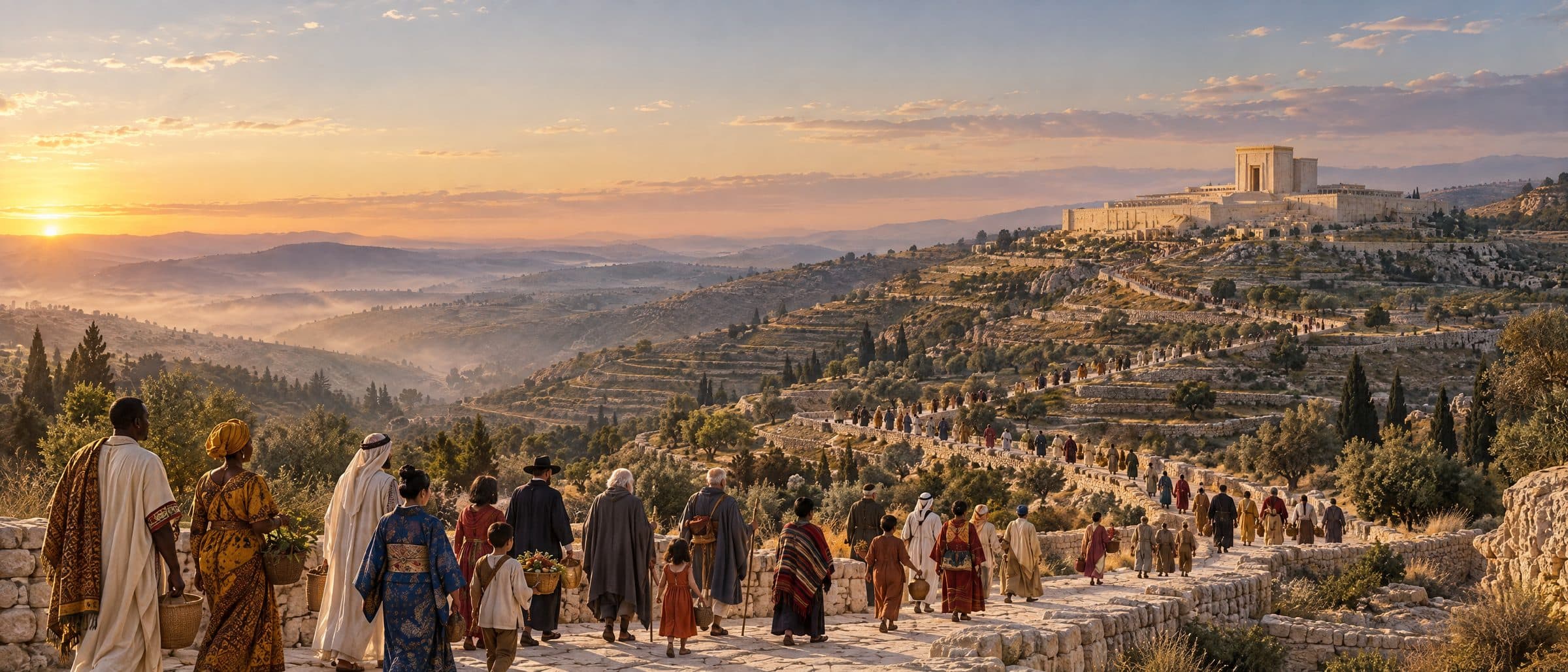
Reconstruction: people of many nations in their own traditional dress walk along terraced roads toward Jerusalem at sunrise; the Temple stands small on the distant ridge.

For Israel, and beyond Israel

Isaiah speaks of foreigners who join themselves to God and are welcomed on the holy mountain. The House is called a house of prayer for all peoples. The same sources also give its courts different degrees of access. A universal purpose and distinct sacred roles sit side by side.

Why it matters beyond Judaism

Explore the House

The courts rise westward, each a step closer to the centre. Choose any part.

Walk the Third Temple
Plan of the Mikdash according to Mishnah Middot, as reconstructed by this site

עזרה

The Azarah (inner courtyard)

The inner courtyard, 187 amot east to west and 135 north to south.

See it in the full model
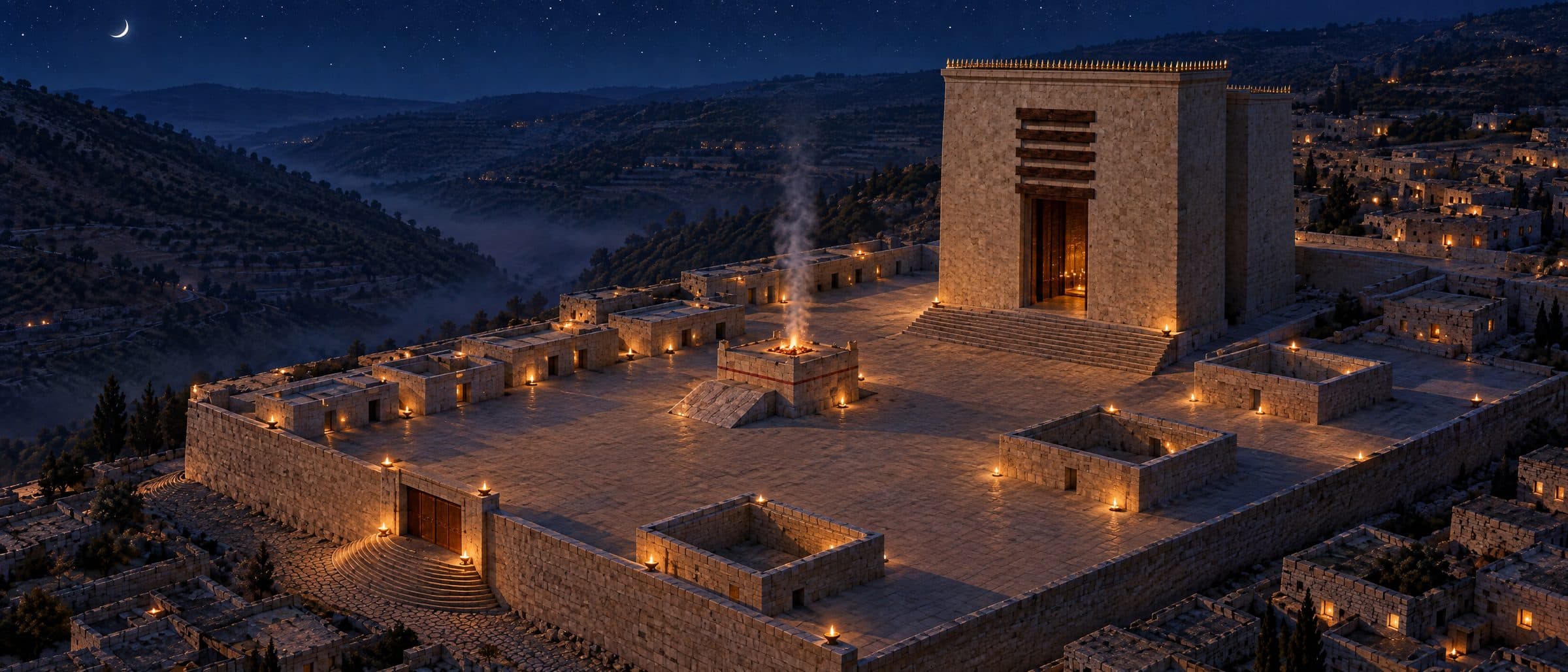
Reconstruction: the Temple platform at night under stars and a thin crescent moon, the Sanctuary's open doorway glowing, the courts lit only by oil lamps and the embers of the altar.

A house in Jerusalem.
A question for the whole world.